
Balancing Stick Pose
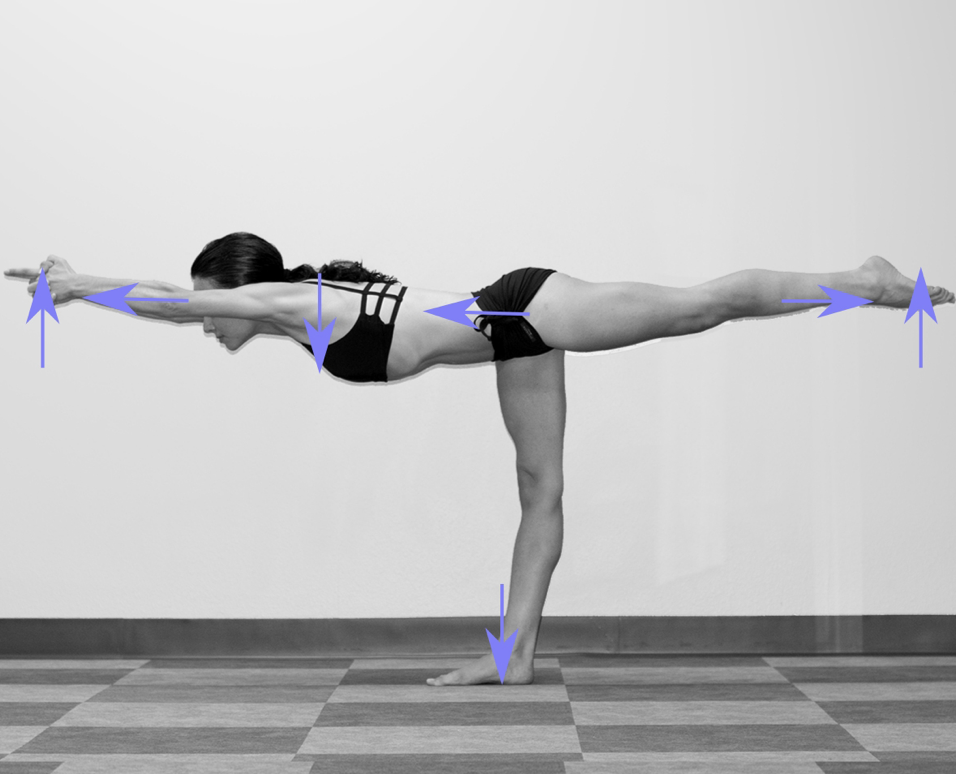
Where is the primary focus? Legs, arms, and abs.
Where does the posture provide maximum benefits? Cardiovascular system, legs, abs, and arms.
When and where could I feel the stretch?
Through the bottom of your arms, if you are lifting them up enough.
In the back of your standing leg, if you are bringing your weight forward enough.
Inner upper thigh of your lifted leg, if you are bringing it up enough.
Through your abs and torso, if you are stretching forward enough.
Why should I do this posture?
It’s short and intense. It will improve your cardiovascular strength, your mental strength, as well as your arms and legs.
How can I improve?
This is a love/hate posture. I really love it when it’s over.
I love the intensity and the challenge, but it’s a huge amount of effort, and to do it correctly takes a lot of thought. I love that there is a lot to think about and try to adjust and that it’s also a very static posture.
The key to the posture, at every step and every level of depth, is using your muscles to create length in your body.
Start by thinking about the step. As soon as I step, I make sure the back foot isn’t turning or pivoting, and the moment my back foot toe is lifted off the floor, I start stretching it back. With the stepping foot, as soon as my foot is down, I try to start the hinge at the waist to bring my upper body down. Regardless of how far you bring your upper body down and your leg up, the key effort is the engagement of your muscles and trying to create the most distance from your lifted toe to your fingertips. Coming down more and getting your body into that “T” shape will become easier with time and as you get stronger. Even if you can’t get your body down and leg up very far, there is still a ton of work to do. Stretching forward can use all of the muscles of your arms; playing with turning more muscles on will bring lots of challenges. This is just as true with the lower body; both legs can be contracted as much as possible.
Once your muscles are active, then it’s fine-tuning that will keep you busy and your mind active.
· Lifting your lifted leg higher and stretching it back will help get it level.
· Turning your inner thigh up so that the sole of your foot faces the ceiling and your knee points down will help create impeccable alignment.
· Sucking your stomach in and up (towards your head) will help create more engagement and space in your torso.
· Bringing your chin forward will help your neck be straight.
· Moving your eyes forward, without changing your head position, will help you keep stretching forward, where your eyes go your body follows.
· With your arms, lifting is as key as stretching forward. Most of our upper backs will round as we move forward (the same thing happens in Half Tortoise Pose) unless we work against that by lifting our arms.
· Squeezing your biceps into your ears will give you more to work on.
· Then there are the hands. Just like in Half Moon Pose, it takes a ton of effort to keep your hands as tight as you can get them. To keep your hands together, try using your hands in many ways at the same time. Squeeze your palms together, your fingers into each other vertically and horizontally, and use your thumbs overlapping each other to provide more strength.
Even though this posture is short, it’s hard. Instead of ever compromising form to stay in it, if you feel your energy dropping, try coming out with integrity. Over time you will build strength, and even then, sometimes it’s too much to stay in it the entire time. Do what you can; there are always more chances to do it again.