
Standing Separate Leg Head to Knee Pose
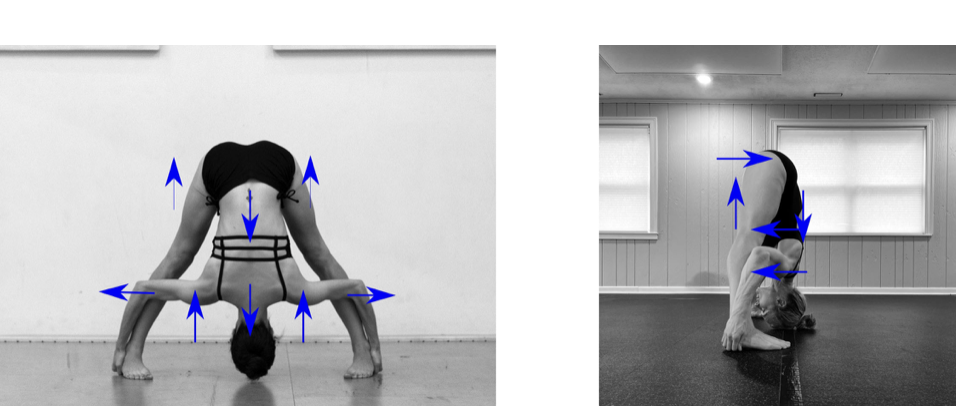
Where is the primary focus? Legs and spine
Where does the posture provide maximum benefits? Quadriceps, spine, shoulders
When and where could I feel the stretch?
Through the back of your legs as you bring your hips forward.
In your shoulders if you are pulling enough.
In your spine as you stretch down.
Why should I do this posture?
It creates stretching through the back of your body. It lowers your head below your heart.
How can I improve?
When I was a brand new teacher, I was at a workshop with Jason Winn, and at some point, I referred to Standing Separate Leg Stretching as the posture you can rest in before Triangle Pose. Jason had a look that seemed to show disdain, disappointment, and curiosity. He then proceeded to make me do Standing Separate Leg Stretching and showed me how to do the posture. How he taught me how to use more engagement and do more work in the posture has stayed with me.
Your legs and your arms do most of the work here, and like all of the sequence, the fine-tuning happens through the rest of your body.
Stretching your arms out and up initiates your arm muscles working at the beginning of the posture as well as the exit. When you move your arms with more precision, it adds strength to your body and focus to your thoughts; it keeps you more present and more involved.
When you step and bring your arms down, bringing them back is just as key to stretching the front of your chest as well as preparing you for what’s going to happen in Triangle.
The distance of your step impacts your ability to stretch your spine, and where the most significant stretch is in your legs. Try a smaller step and see where you feel the stretch in your legs, and try a bigger step to see where you feel the stretch. It's not that one area is more important or better or even right; this entire practice is about inquiry.
The more we can get interested in how something feels, what our body needs, and what our head needs, the more effective the practice is. Like so many parts of this practice and life, there are paradoxes involved, like being curious about how different you feel with different movements while still staying inside the constructs of the practice. For me, the wider I step, I feel the stretch lower down the back of my thighs, and the smaller my step, the higher up my thighs I feel the stretch.
You used to hear teachers talk about touching your head to the floor, which was always a target to motivate you to stretch as opposed to a benefit. The problem is that often when people touch their heads to the floor, they then transfer weight into their heads, compressing their spine instead of lengthening it. If you can touch your head to the floor, take a smaller step.
Turning your toes in towards each other creates an internal rotation of your legs which helps you fold forward. To finish off the set up, pushing your hips forward brings your weight forward. Lifting your chest up and bringing your chin up creates a slight backward bend that helps keep your spine straight as you enter the posture.
The slower you move in the entrance, you build more strength than just flopping into it. You increase your balance skills by bringing your weight forward. I like to lift my heels to exaggerate the weight forward and to slow down my descent; then I can slide my fingers under my heels with no extra movements.
Once you have your grip, there are those familiar layers of work. It starts with your arms; you can start pulling on your heels. Bending your elbows, bringing your elbows to the back and your shoulders up not only makes your arms work, it helps stretch your spine. Sucking your stomach in and up will help lengthen your spine as well.
Your neck is an important part of your spine; stretching your head towards the floor helps lengthen your entire spine.
If that’s not enough work for you, you can squeeze your legs towards each other without letting them move which creates an isometric contraction on your legs.
For the exit, stretching forward in order to come up with as straight a spine as you can will further help you build strength. Making the rest of your exit crisp and mindful once again creates the challenge of doing more and keeping you present instead of just going through the motions.
All of the work of course, depends on your energy in that moment. Sometimes it’s all you can do to do any part of the posture, while some days it feels like you can do anything. I encourage you to layer on the engagement as you can.